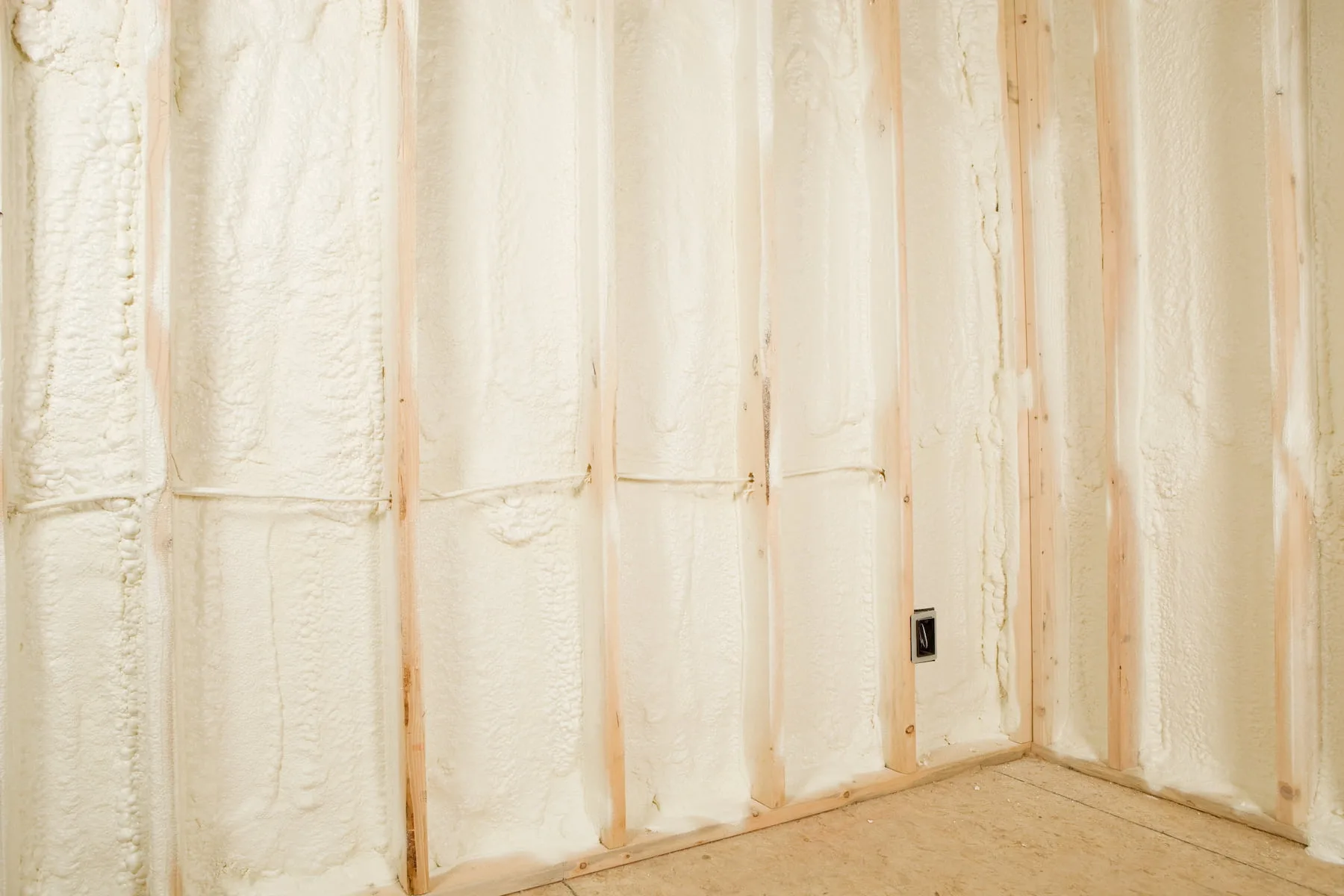
Spray Foam and the Building Envelope
Spray foam provides a number of key features that are essential in Building Envelope design including:
- Continuous Insulation – High R-value
- Improved Airtightness Air Leakage Control
- Moisture Control
- Sound Control
Depending on application details, the use of spray foam can reduce or eliminate the need for:
- Fasteners,
- Supplemental tapes and sealants,
- Supplemental venting
- Vapor Retarder Membranes
- Air Barrier membranes, and
- Water Resistive Barrier membranes
The savings on application times and costs can be substantial.
Unvented
Attics

Spray foam offers unique performance improvement opportunities in unvented attics particularly if there are mechanical systems—heating, cooling and ventilating systems —in the attic.
- Because it is air impermeable, attic venting is not required when spray foam is used
- Insulating at the roof-line keeps ducts and equipment in conditioned space where it is more efficient to operate
- Air leakage to the exterior from attic ductwork is eliminated
- The attic will be indirectly conditioned by heating and cooling equipment in the attic as well as through heat exchange through the attic floor
And spray foam unvented attics are less susceptible to rain ingress and ingress of sparks and embers from adjacent wildfires. They even have added strength to resist wind uplift in hurricane and high wind events.
Vented
Attics

Even in traditional vented attics, there are numerous advantages to using spray foam. Spray foam can:
- Quickly fill gaps around electrical, plumbing and mechanical penetrations in the attic floor
- Encapsulate and bond to framing to provide continuous insulation throughout
- Bond to wall top plates for a continuous air seal
In addition, spray foam can flex with truss movements for a durable seal.
Exterior of
Walls

When applied on the exterior of wall sheathing, spray foam can provide a:
- Continuous Air Barrier
- Water Resistive Barrier to avoid rain ingress
- Continuous Insulation to help keep wall cavities warmer and free of condensation
- Reduced dependence on flashings, tapes and sealants for sealing
In addition, spray foam bonds to the sheathing to help ensure wind and rain do not travel around the insulation compromising its performance.
Wall
Cavities

In wall cavities, spray foam can provide:
- High R-value in small, limited cavity spaces
- Air leakage control
- Vapor diffusion control
- Effective insulation of walls in bay and bow windows, curved walls etc.
And spray foam can provide increased racking strength/wind resistance to counter the effect of high winds and other forces.
Floors Over
Unheated
Space

Over unheated space, spray foam helps keep floors warm and comfortable in winter, cool in summer. Like other areas it can provide high R-value and a continuous Air Barrier in a limited space. In addition, spray foam:
- Adheres so there is no need for fasteners or clips
- Does not settle or sag
- Can be used to encapsulate heating ducts and protect plumbing from freezing
Spray foam simplifies insulation of cantilevered floors over entryways, bonus rooms over garages and entire floors over unheated crawl spaces, plus, spray foam helps avoid the ingress of garage fumes, and moisture from damp spaces.
Exterior of
Basement and
Crawlspace
Walls

On the exterior of Basement and Crawlspace Walls, a continuous blanket of spray foam on the exterior provides:
- Continuous insulation to keep walls warm
- A barrier to moisture ingress to keep basements and crawlspaces dry
Leaving maximum space on the interior for interior finishing and use.
Interior of
Basement
and
Crawlspace

A continuous layer of spray foam on the interior of basements and crawlspaces provides:
- Thermal and moisture control for the interior
- A barrier to radon and soil gasses when spray foam also extends under the floor slab to create a ‘bathtub” barrier protecting the basement.
Extending the spray foam up into the joist area can complete the air seal at sill plates and band/header joists. In many houses, this is one of the leakiest areas of the building envelope.